
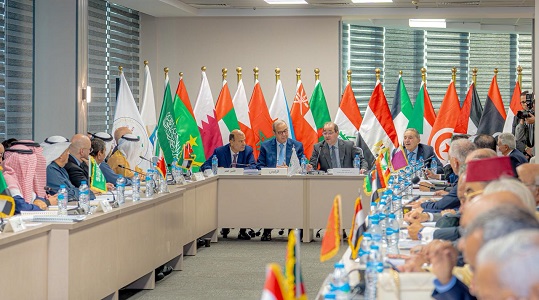
The 136th session of the Board of Directors of the Union of Arab Chambers was held in the Egyptian capital, Cairo, on 20 December 2025, following a kind invitation from the Federation of Egyptian Chambers of Commerce, chaired by Ahmed El Wakil, and under the patronage and in the presence of the Minister of Finance of the Arab Republic of Egypt, Ahmed Kojok. The meeting was attended by delegations from 18 Arab countries, represented by chamber presidents, members of boards of directors, federations of chambers, and the League of Arab States.
At the outset of the Board meeting, a dialogue session took place between the Egyptian Minister of Finance, Ahmed Kojok, and the Arab private sector, represented by chamber presidents, board members, federations of chambers, and the League of Arab States.
The discussion focused on the concerns of the Arab private sector and mechanisms for developing cooperation in the coming period, as well as the steps undertaken by the Arab Republic of Egypt to ease restrictions that would contribute to attracting foreign investments, particularly from Arab countries.
In his remarks, the Egyptian Minister of Finance stressed the importance of a strategic partnership between the public and private sectors, emphasizing that the success of states and governments is intrinsically linked to the success of the private sector. He also reviewed the measures taken and being taken by the Egyptian government, the Ministry of Finance, and all relevant authorities to achieve economic advancement.
Following the conclusion of the dialogue session between the pillars of the Arab private sector and the Egyptian Minister of Finance, the activities and proceedings of the 136th session of the Board of Directors of the Union of Arab Chambers officially commenced.
The meeting opened with a speech by the President of the Union of Arab Chambers, Samir Majoul, in which he expressed his sincere thanks and appreciation to the Federation of Egyptian Chambers of Commerce, represented by its President Ahmed El Wakil, as well as to the members of the Board of Directors and the executive apparatus, for their generous hosting, the efforts exerted to ensure the success of the meetings, the excellent organization, and the warm hospitality and reception.
He wished the Federation of Egyptian Chambers of Commerce further progress, prosperity, and achievements in the service of the private sector and the economy of the Arab Republic of Egypt, which today, thanks to the vision, wisdom, and efforts of His Excellency President Abdel Fattah El Sisi, is witnessing a significant renaissance, prosperity, and openness. This has enabled Egypt to occupy a prominent position not only at the level of the Arab world, but globally.
He also welcomed all colleagues, presidents and members of the boards of directors of Arab chambers and their federations, giving special mention to the President of the Federation of Syrian Chambers of Commerce, Alaa Omar Al Ali, and the President of the Sudanese Businessmen Federation, Moawia Al Bareer, who were attending for the first time. He wished them success in their duties, in a manner that serves the economies of their respective countries.
Majoul stated that there is great hope that this session will represent a bright and sustainable milestone on the path toward strengthening the role of the Union of Arab Chambers in the process of developing, growing, and advancing the Arab economy. He extended thanks and appreciation to the General Secretariat of the Union for its commendable efforts, and to the Secretary General for his tireless work in unifying visions, strengthening joint Arab action, and enhancing the performance and initiatives of the Union in a way that serves the interests of the Arab private sector and supports comprehensive and sustainable development paths in Arab countries.
He called for further cooperation and coordination, unification of visions, and enhancement of the Union’s performance and initiatives, along with exerting efforts to continue strengthening the role of the Union of Arab Chambers in developing, growing, and advancing the Arab economy, especially in light of the global transformations that require additional decisions and measures to help adapt to these changes. He stressed the need to become a key player with tangible impact amid the remarkable developments witnessed at the economic, industrial, and global supply chain levels, particularly given the vast natural and human resources available to Arab countries.
For his part, Ahmed El Wakil, President of the Federation of Egyptian Chambers of Commerce, expressed his appreciation to the Arab brethren, presidents of Arab chambers of commerce and members of the Union of Arab Chambers, for their unprecedented participation in the meetings of the 136th session of the Board of Directors of the Union of Arab Chambers, hosted by Egypt in Cairo, with the participation of 18 countries. He also welcomed the keenness of Dr. Ahmed Kojok, Minister of Finance, to participate in the activities of this meeting.
El Wakil stated in his speech that he would not elaborate on the legislative and procedural revolution and other economic reform mechanisms led by the government in full partnership with the private sector, represented by the Federation of Egyptian Chambers of Commerce, nor on their impact on the macroeconomy, the business environment, and the influx of Arab and international investments into Egypt, noting that the Minister would be more capable of presenting these issues.
He added that, as representatives of the Arab private sector, there is a strong aspiration for a genuine partnership that develops Arab peoples and states and creates added value and job opportunities for future generations, through integrating comparative advantages, particularly by enhancing cooperation in industry, whether jointly or in partnership with global companies. This includes providing production inputs, manufacturing equipment, and training, with the aim of joint manufacturing not only for local and Arab markets, but also for export to global markets, in addition to new industrial and service investments.
In turn, the Secretary General of the Union of Arab Chambers, Dr. Khaled Hanafy, affirmed that the participation of the Egyptian Minister of Finance in the Board meeting reflects the government sector’s interest in listening to the views and perspectives of the Arab private sector, and confirms the existence of a real and effective partnership between both sides to advance the economic and investment landscape in the Arab world.
He considered the role of Arab governments to be essential and pivotal, but emphasized that governments cannot succeed without the private sector. Therefore, governments must open doors to the private sector to build strong Arab economies, especially since the Arab private sector contributes more than 75 percent of employment opportunities and approximately 80 percent of GDP. Given this contribution, all conditions necessary for the success of this vital sector must be provided.
The Secretary General reviewed the prominent roles and activities undertaken by the Union of Arab Chambers, particularly throughout 2025. He also presented to the Board the Union’s vision and activities for the coming year, which aim to further enhance the role of the Arab private sector.
He explained that the agenda of this session includes procedural, strategic, and events-related items. The procedural items focused on reviewing the report on the activities and events of the General Secretariat of the Union, a special item related to financial matters, as well as issues concerning joint Arab-foreign chambers of commerce. The agenda also included memoranda on initiatives and projects planned for implementation by the Union in the interest of Arab countries at both economic and social levels. Strategic items included important studies addressing emerging economic issues at the Arab and international levels, in addition to upcoming Union events, and other issues falling within the framework of strengthening the role of the Union of Arab Chambers amid accelerating geopolitical changes in the Arab world and globally.
During the session, a number of strategic issues and items related to developing the Arab economy and private sector were discussed, in line with global transformations in digital transformation, artificial intelligence, renewable energy, and other vital fields that contribute to achieving sustainable development goals in Arab countries.
A number of important initiatives were launched, including support for Palestinian chambers of commerce and the Palestinian private sector, represented by the Federation of Palestinian Chambers of Commerce, Industry, and Agriculture, to enable these chambers to perform their effective economic role.
The President of the Oman Chamber of Commerce and Industry presented an initiative to support the Palestinian private sector by organizing an exhibition in the city of Amman, in the Hashemite Kingdom of Jordan, for Palestinian products, to promote them and facilitate their entry into Arab countries exempt from taxes. This initiative is to be implemented in coordination and cooperation with the Jordan Chamber of Commerce, with the Omani chamber expressing its readiness to provide financial contributions toward holding the exhibition.
In turn, the President of the Jordan Chamber of Commerce praised this initiative, considering it part of the efforts and assistance provided by the Chamber to alleviate the suffering of the Palestinian people in Gaza and the West Bank. He welcomed hosting the exhibition in Amman as an important gateway to supporting the Palestinian private sector in both its agricultural and industrial branches.
The participants also announced their support for the effective return of the Federation of Syrian Chambers of Commerce, which expressed its commitment to fulfilling all obligations, affirming that the Arab private sector stands ready to actively participate in supporting recovery and stability in Syria.
The participants commended the role achieved by the Union of Arab Chambers in recent years in strengthening economic relations, whether among Arab countries or between Arab and foreign countries through Arab, foreign, and joint chambers. The Union has expanded its relations with regional and international organizations, notably the International Labour Organization and the World Trade Organization, where negotiations are underway for the Union to join as an observer member, with significant progress achieved. It has also strengthened ties with the International Chamber of Commerce, UNIDO, and other prominent international organizations, making the Union influential not only at the Arab level but also at the regional and international levels.
The Executive Committee of the Union convened and discussed the items listed on the Board’s agenda, submitting its recommendations to the Board of Directors, which adopted the appropriate decisions accordingly.
Based on the recommendations of the Executive Committee, the Board decided to provide financial support amounting to three hundred thousand (300,000) US dollars, to be distributed among Arab chambers according to their contribution ratios to the Union’s budget. This support aims to strengthen the capacities of the Federation of Palestinian Chambers, enabling it to support the Palestinian private sector in its efforts related to reconstruction in the Palestinian territories.
To activate sectoral work and develop economic relations among Arab countries, the Board approved a proposal submitted by the Federation of Egyptian Chambers to establish a number of sectoral committees, similar to practices adopted by comparable regional organizations such as the Union of Mediterranean Chambers and the BRICS Business Council.
In this context, approval was granted to initiate the establishment of committees for the following sectors:
- Transport, logistics, and value chains,
- Industry, its deepening, and integration of its inputs,
- Food security (agriculture and processing),
- Conventional energy and new and renewable energy,
- Entrepreneurship and support for small and medium-sized enterprises.
It was also decided that these sectoral committees, composed of representatives from Arab countries nominated by their respective chambers or federations of chambers, will be tasked with studying ways to advance the relevant sector, proposing appropriate mechanisms to develop Arab cooperation and integration in this regard, and submitting their recommendations to the Board of Directors of the Union for implementation.
For this purpose, the Federation of Egyptian Chambers and the General Secretariat of the Union of Arab Chambers were mandated to work together and coordinate with other Arab chambers and federations to establish mechanisms for implementing this important decision.
Source (Union of Arab Chambers)
