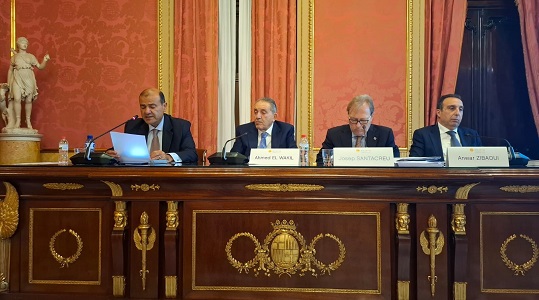
The Secretary-General of the Union of Arab Chambers, Dr. Khaled Hanafy, confirmed during the high-level panel on promoting industrial and economic development in the Mediterranean region, held within the Euro-Mediterranean Economic and Trade Forum 2025 — which coincides with the 30th anniversary of the “Barcelona Declaration,” organized by the Association of Mediterranean Chambers of Commerce and Industry (ASCAME), the Barcelona Chamber of Commerce, the European Institute of the Mediterranean, and the Secretariat of the Union for the Mediterranean — that the Barcelona Declaration constituted a visionary framework that placed economic cooperation and joint development at the heart of regional stability. Despite global and regional crises, the process strengthened institutional dialogue and expanded trade and exchanges between peoples.
Today, the challenge lies in shifting from cooperation to integration and transforming the Mediterranean region into a space for industry and innovation.
Dr. Khaled Hanafy pointed out that the industrial landscape in the Mediterranean region is witnessing rapid changes: energy transitions, digitalization, green manufacturing, and circular-economy practices are reshaping competitiveness. However, industrialization remains uneven: manufacturing still accounts for around 14% of GDP in the Arab region and less than 16% in parts of Southern Europe and North Africa. To close this gap, we need to build regional value chains that connect production networks between the North and South and invest jointly in logistics, renewable energy, and technology transfer. At the Union of Arab Chambers (UAC), we are calling for the creation of an Arab–European industrial corridor linking Mediterranean ports, industrial zones, and digital infrastructure to strengthen joint production and exports to Africa and Asia.
He noted that the strategic location of the Mediterranean — connecting Europe, Africa, and Asia — provides unmatched potential in logistics, renewable energy, and green industry. Priority actions include:
- Modernizing infrastructure through public-private partnerships and investing in transport corridors, ports, and energy-grid interconnections.
- Accelerating the green transition by expanding renewable-energy projects, green hydrogen, and sustainable industrial zones.
- Leveraging digital transformation — where artificial intelligence, data analytics, and Industry 4.0 can enhance manufacturing productivity and sustainability.
Within this context, the Union of Arab Chambers supports initiatives that align industrial competitiveness with climate responsibility, in line with the Paris Agreement and the Sustainable Development Goals.
He believed that the 30th anniversary of the Barcelona Declaration is an opportunity to redefine our collective vision for the next generation. On this basis, the Union of Arab Chambers (UAC) proposes strengthening public-private dialogue mechanisms within the Union for the Mediterranean to ensure that the private sector contributes to shaping the region’s industrial and trade agenda.
He concluded by saying: “Thirty years ago, the Barcelona Process began with a vision of partnership. Today, we must transform that vision into tangible integration. In this context, the Mediterranean can — and should — become a model of balanced, sustainable, and inclusive industrial development, built on cooperation between governments, chambers of commerce, and companies.”
During the Secretary-General’s speech at the launch of the “Barcelona Declaration” for the private sector, Dr. Khaled Hanafy emphasized that launching the Barcelona Declaration for economic development in the Mediterranean region represents a renewed commitment to shaping a more resilient, prosperous, and cohesive Mediterranean — a region that turns global challenges into drivers of regional opportunity.
He stressed that “the future of the Mediterranean will only take shape through its ability to unite around a shared vision — one in which economic resilience is built through cooperation, prosperity is shared across borders, and innovation becomes the language of progress. From policymakers to entrepreneurs, from chambers of commerce to startups, every partner has a role to play. Together, we can turn our shared sea into a shared future, one defined by opportunity, stability, and prosperity.”
He considered that “the Barcelona Declaration for Economic Development in the Mediterranean region is much more than a document. It is a powerful call to action. It serves as a collective call for governments, institutions, and private-sector leaders to adopt a new charter for the Mediterranean — one that places sustainable development, inclusive growth, and regional cooperation at its core. It urges us to move beyond lofty rhetoric and toward shared responsibility and commitment that deliver transformative impact.”
The Secretary-General noted that the Mediterranean is not a boundary but one of the busiest economic corridors in the world, with more than 20% of global maritime trade passing through it. He pointed out that “the real opportunity now lies in transforming this interconnectedness into integrated value chains,” calling for “the creation of a Mediterranean hydrogen exchange hub — the first platform for pricing, contracting, and matching southern hydrogen producers with industrial buyers in Europe; alongside establishing a Mediterranean agri-food manufacturing chain supported by a unified accreditation system — the Unified Mediterranean Industrial Certificate — to reduce compliance times by 30 to 40 percent; and creating a joint Euro-Arab pharmaceutical and health-security value chain through a regional drug market exceeding USD 50 billion, supported by new cross-border clusters under the MED-30 initiative.”
He concluded: “This is the decade of action, not the decade of waiting or repetitive conferences. The region has enough geography to compete and enough history to lead. We do not need permission to build the future; we need partnership — and a shared language of industry and innovation. Our strength is not in our differences, but in the value chains we can build together.”
Source (Union of Arab Chambers)
