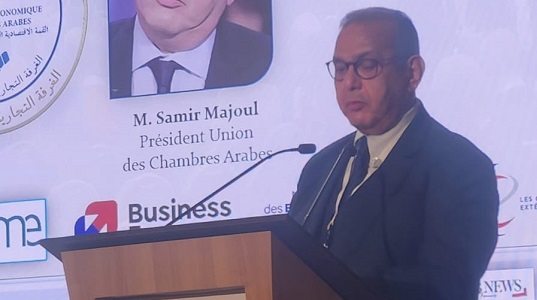
The President of the Union of Arab Chambers and President of the Tunisian Union of Industry, Trade and Handicrafts, Samir Majoul, affirmed during the sixth session of the French–Arab Economic Summit — held from 10–11 December 2025 under the patronage of the President of the French Republic, Emmanuel Macron, and under the theme: “Water and the Environment at the Core of Needs, Crises, and Opportunities in the Arab World,” and in the presence of a large gathering of ministers, presidents of Arab and French chambers, business leaders, company heads, the Council of Arab Ambassadors in Paris, the President of the Arab–French Chamber of Commerce, and the Secretary-General of the Chamber — that “this summit embodies the strength of a strategic relationship built over decades, a relationship that today forms the core of our shared priorities in sustainable development, environmental security, and mutual prosperity.”
He noted that “the subject raised by the summit — ‘Water and the Environment at the Core of Needs, Crises, and Opportunities in the Arab World’ — accurately reflects the scale of the challenges we face. Water tensions, environmental pressures, and the impacts of climate change directly affect the economic, social, and human balance of our societies. In many Arab countries, the availability of fresh water has reached critical levels, highlighting the urgent need for collective action based on innovation, investment, and international solidarity.”
The President of the Union, Samir Majoul, considered that “this reality requires an intensified mobilization of all concerned parties. Arab countries are making significant efforts to modernize the management of their water resources, develop renewable energy sources, enhance the circular economy, and strengthen the resilience of their lands. France, for its part, possesses leading expertise in these fields, in addition to a business network capable of efficiently supporting major sustainable transformation projects.”
He emphasized that “the convergence of our interests paves the way for a renewed and ambitious partnership. The private sector — represented at the Arab level by the Union of Arab Chambers — plays a decisive role in this dynamic. Through structuring investments, transferring technology, jointly developing projects, and supporting the energy transition, it can become a key driver of sustainable solutions.”
He stressed that “this summit is not merely a forum or a meeting for discussion, but a platform for interaction and an opportunity to build solid alliances and shape an economic vision based on shared responsibility and mutual benefit. What connects our two regions goes far beyond trade; it is a historical, cultural, and human relationship that enables us today to envision an ideal model of cooperation.”
President Samir Majoul called for “strengthening economic dialogue frameworks between the Arab world and France; encouraging public–private partnerships focused on water infrastructure, clean energy, and sustainable resource management; and supporting innovation driven by young entrepreneurs, who represent an essential creative force for environmental transformation and for enhancing the competitiveness of our economies in the future.”
Khaled Hanafi
For his part, the Secretary-General of the Union of Arab Chambers, Dr. Khaled Hanafi, presented a set of important and prominent proposals and initiatives to enhance Arab–French bilateral relations. Among these initiatives were: establishing an Arab–French Innovation Zone for scarce resources; developing low-carbon desalination technologies; boosting digital agriculture; launching and creating a map of investment opportunities; launching a platform for green value chains; linking Arab, French, and international banks to finance desalination and recycling projects; creating an Arab platform for French challenges; and aligning Arab investors with French companies operating in green technology.
He considered that “geopolitical and economic shifts form a complex and pivotal reality for our Arab nation, especially amid the environmental and water challenges that have intensified in recent years. The Arab region is witnessing major political transformations — from conflicts to regional rivalries to the redrawing of alliances — and these transformations directly affect trade, investment, and supply chains.”
The Secretary-General explained that “the Arab region suffers from the highest levels of water scarcity in the world. With rising temperatures and declining renewable water resources, governments have become compelled to rearrange their investment priorities. Between 70 and 85 percent of water in several Arab countries is allocated to agriculture, making water scarcity a direct threat to food security. Climate change is also reshaping energy policies, especially with the move toward renewable energy to reduce pressure on water resources used in cooling and production.”
Dr. Khaled Hanafi noted that “current challenges have pushed the private sector to adopt new business models and initiatives based on water technology, energy efficiency, natural resource management, and the development of more flexible and sustainable value chains. Consequently, water and climate issues have become central to shaping the Arab economic agenda for the coming years and in directing investment policies and international cooperation.”
The Secretary-General revealed that “five key sectors now represent promising opportunities for strategic partnership between the Arab world and France. These five sectors also form a solid foundation for an Arab–French partnership capable of generating new economic value and achieving regional sustainability goals. They are: water desalination using renewable energy; water management and recycling; smart agriculture and agri-technology; renewable energy and energy storage; and the circular economy and waste management.”
He stated that “the Union of Arab Chambers can play a fundamental role at economic, investment, and institutional levels through four main pillars: building platforms for cooperation and linkage between the public and private sectors; supporting the financing of water and environmental projects; developing the business environment and empowering small and medium-sized enterprises; and enhancing knowledge, technology, and the exchange of expertise.”
Dr. Khaled Hanafi explained that “while many Arab countries face increasing needs for investment in water infrastructure, upgrading supply networks, and developing solutions based on clean technology, the world is witnessing, at the same time, a growing demand for partnerships capable of connecting international investments with green-transition plans. Hence the importance of Arab–French cooperation, which has become a stabilizing factor, a driver of innovation, and a bridge between the visions of our economies and the opportunities of global markets.”
He added: “As water-related needs increase, the need for innovative financing models and economic tools capable of mobilizing public and private investments deepens as well. Water projects are essential infrastructure for agriculture, industry, business attractiveness, and a fundamental requirement for the stability of societies. From our position at the Union of Arab Chambers, we reaffirm our commitment to supporting these efforts and working with our partners in France to provide a cooperative environment that transforms this investment momentum into tangible results on the ground.”
The Secretary-General stressed that “the challenges before us are significant; however, what we have witnessed of genuine will on both the Arab and French sides gives us confidence that this summit can deliver real added value — not only at the level of its recommendations, but also through the new paths of partnership it will open, and through its role as a platform where the interests of the public and private sectors, of states and institutions, and of French expertise and growing Arab needs come together. In this regard, I can only extend my thanks to the Board of Directors of the Arab–French Chamber of Commerce — particularly its President, Vincent Reina, its Secretary-General, Rayan Kanaan, and the entire working team — for their role in ensuring the success of this summit and in organizing its sessions with precision and professionalism.”
Source (Union of Arab Chambers)
