The Secretary-General of the Union of Arab Chambers, Dr. Khaled Hanafy, affirmed during his speech at the World Industry Summit, which was held in Riyadh, Kingdom of Saudi Arabia, organized by the United Nations Industrial Development Organization (UNIDO), and attended by delegations from 176 countries in addition to heads of governments and ministers, including the Saudi Minister of Investment, H.E. Eng. Khalid Al-Falih, the Bahraini Minister of Industry and Commerce Abdullah bin Adel Fakhro, and the Director-General of UNIDO, Gerd Müller, that “the creative (orange) economy, with a global value of 2.5 trillion US dollars, is considered one of the fastest-growing sectors, providing millions of jobs and driving exports in fashion, film, design, handicrafts, and digital media. For the Arab region, this sector represents a strategic opportunity to diversify economies beyond oil and traditional industries, especially by engaging young and female entrepreneurs.”
He noted that digital tools and artificial intelligence are transforming the way creative goods and services are produced, distributed, and monetized — from AI-assisted design and smart fashion to virtual museums and immersive tourism. From this perspective, the Arab region — rich in cultural heritage — can leverage artificial intelligence and digital storytelling to export its narratives to the world, creating soft power and new tourism and commercial opportunities. In this context, the Union of Arab Chambers is working to integrate creative industries into broader economic and industrial policies through national chambers and regional partnerships. The Union is also developing initiatives that facilitate access for creative entrepreneurs to innovative financing (including microfinance, Islamic finance, and venture capital for design and digital start-ups).
Dr. Khaled Hanafy called for establishing a regional strategy for the creative economy that integrates trade, innovation, and education policies to nurture a generation of “creative entrepreneurs.” He stated that as the Union of Arab Chambers — alongside the UNIDO Investment and Technology Promotion Office (UNIDO ITPO) in Bahrain and all partners — the goal is to make the Arab orange economy a global success story.
He considered integration the key to growth, as linking small and medium-sized enterprises (SMEs) to new procurement and export markets enables them to scale their operations and participate in regional value chains. He added that promoting green supply chain practices helps SMEs meet sustainability standards and benefit from the rising demand for ethical, low-carbon products. To achieve this transformation, a new agreement is needed between the public and private sectors focusing on three dimensions:
Policy coordination: governments, development finance institutions, and chambers of commerce must align SME financing policies with national industrial priorities and regional integration frameworks.
Innovation and inclusion: innovative financing models — such as Islamic venture capital, micro-sukuk, and credit guarantee funds — must be expanded to unlock the potential of young and female entrepreneurs.
Partnerships: cooperation should be deepened among institutions such as UNIDO, the Higher Council for Islamic Finance Standards and Review, the African Union for Economic Development, the African Development Bank, and the African Union for Economic Development, to ensure that financial innovations translate into inclusive manufacturing on the ground.
During his participation in the high-level side event organized by the United Nations Industrial Development Organization as part of the World Industry Summit under the title: “Enabling Bilateral Investment with the Middle East: Leveraging Economic Diversification for Mutual Growth,” which witnessed the attendance of the Saudi Minister of Investment, Eng. Khalid Al-Falih, the Bahraini Minister of Industry and Commerce Abdullah bin Adel Fakhro, and the Director-General of UNIDO Gerd Müller, Dr. Khaled Hanafy stressed that the World Industry Summit is being held at a time when investment and industrial policies have become top priorities on national agendas. He explained that investments in energy and infrastructure remain significant in the region. According to the International Energy Agency, energy investments in the Middle East amounted to about 175 billion US dollars in 2024, but only around 15% of this capital went to clean energy — a gap that must be addressed to align investments with climate and diversification goals.
He clarified that based on the region’s competitive advantages, four sectors stand out as the most influential for bilateral investment: first, renewable energy and green industries; second, minerals and advanced materials (including mining of critical minerals); third, technology, digital services, and advanced manufacturing; and fourth, financial services and green finance.
He noted that to build a new era of bilateral investment that truly supports economic diversification, the future direction must focus on innovation, partnerships, and inclusiveness — through establishing smarter investment systems, reimagining finance for sustainability, enabling local value creation, embedding sustainability and technology at the core of industrial transformation, and fostering a culture of regional partnership.
He concluded by saying that diversifying the economy in the Middle East is not merely a practice, but a strategic, social, and economic endeavor that requires coordinated efforts between governments, the private sector, chambers of commerce, institutions, and international partners. Bilateral investment must aim not only at transferring capital but also at expanding opportunities, creating sustainable jobs, and ensuring the competitiveness of industries in a low-carbon future.
In a session held as part of the World Industry Summit under the title: “Exploring Global and Islamic Financing Opportunities for Economic Transformation,” and attended by the Bahraini Minister of Industry and Commerce Abdullah bin Adel Fakhro, the Secretary-General of the Union affirmed that “across the Arab region, SMEs represent more than 90 percent of private enterprises, provide around two-thirds of employment opportunities, and play a critical role in trade, innovation, and social inclusion. However, they contribute less than 30 percent of GDP in most Arab economies. This gap does not reflect a lack of entrepreneurship, but rather a lack of enabling systems that allow SMEs to grow, integrate into formal markets, and access affordable finance.
He pointed out that according to the International Finance Corporation, the financing gap for SMEs in the Arab world exceeds 250 billion US dollars, and more than 50 percent of small businesses are underserved by banking services. From this perspective, at the Union of Arab Chambers (UAC), which represents chambers of commerce in 22 Arab countries in addition to 16 joint Arab–foreign chambers, the mission is to empower the private sector to become a driver of inclusive growth. To this end, the Union has worked to facilitate access to finance with the Arab Bank for Economic Development in Africa (BADEA), the Islamic Development Bank (IDB), and now with UNIDO to design blended financing mechanisms that combine Islamic finance principles with development finance instruments. This has helped reduce the risks of lending to SMEs, attract private sector investors, and encourage Sharia-compliant financing for productive sectors such as agribusiness, renewable energy, and manufacturing.”
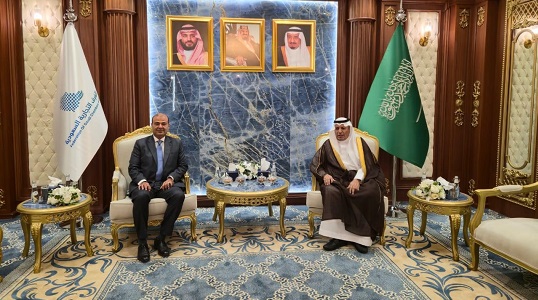
Furthermore, the President of the Federation of Saudi Chambers, Hassan bin Mujib Al-Huwaizi, received the Secretary-General of the Union of Arab Chambers, Dr. Khaled Hanafy, at the Federation’s headquarters in Riyadh, where discussions were held on strengthening joint cooperation and the constructive role played by the Arab private sector in elevating the state and prospects of Arab economies, enhancing development, creating job opportunities, and contributing to GDP.
Dr. Khaled Hanafy also met with the Bahraini Minister of Industry and Commerce, where discussions addressed the importance of strengthening cooperation with China and Italy and establishing innovation- and AI-driven industrial complexes in Bahrain with strong support from the Union of Arab Chambers.
He also met with the President of Polytechnic University, considered the largest university in Milan, where the focus was on completing the necessary arrangements for the university to establish a presence in the Arab region to develop human infrastructure in technical fields.
Source (Union of Arab Chambers)
