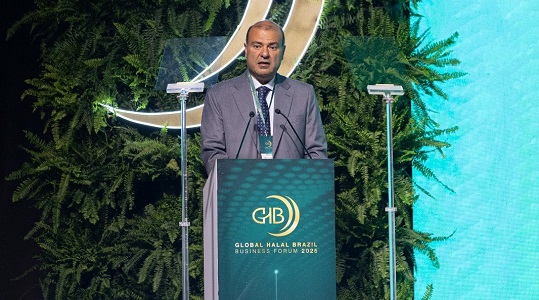
The Secretary-General of the Union of Arab Chambers, Dr. Khaled Hanafy, affirmed during the opening of the third edition of the Brazilian Global Halal Forum, held from October 27 to 28, 2025 in São Paulo, Brazil, organized by the Arab Brazilian Chamber of Commerce and the Federation of Muslim Associations in Brazil, with high-level participation from ministers, officials, bodies, and organizations from both the Arab and Brazilian sides, that the halal industry has become an integrated economic system valued today at USD 1.9 trillion, spanning more than 60 countries worldwide.
He noted that this vast scale reflects the growing demand not only in Islamic countries but also in major global markets, considering that we are now facing major challenges, foremost among them climate change and pressure on natural resources. This, he explained, requires developing halal products and services that do not only comply with religious and legal standards but also take environmental and social criteria into account. Such an approach, he added, fully aligns with the United Nations Sustainable Development Goals, making the halal sector a key player in supporting the global green economy.
The Secretary-General emphasized that the Union of Arab Chambers has, since its founding, worked to strengthen trade and investment cooperation between Arab countries and their partners around the world. He pointed out that the halal industry could become one of the main pillars of such cooperation — not only through trade but also via partnerships in research and development, technology transfer, capacity building, and innovation in products and services.
He stressed the need today for new strategies that focus on diversifying halal markets, developing more flexible and transparent supply chains, and enhancing the efficiency of accreditation and certification systems, thereby increasing consumer confidence and boosting the competitiveness of halal products globally.
Dr. Hanafy revealed that Brazil’s exports to the member states of the Arab League reached USD 23.68 billion in 2024, marking a 22.41% increase over the previous year. Meanwhile, from January to September 2024, companies participating in the Halal Brazil project exported halal products worth USD 3.61 billion, an increase of 20.48% compared with the same period of the previous year.
Brazil’s halal food exports have reached around USD 5 billion in recent years, particularly in chicken and meat products.
The Secretary-General chaired the sixth session of the forum titled “Strategic Partnerships: Brazil and Islamic Countries – Success Stories and Opportunities.” He noted that the global halal market is valued in the billions of dollars, with the broader halal economy often estimated at around USD 7 trillion, and projected to reach USD 10 trillion by 2030.
He also disclosed that the halal logistics sector (including cold chains, packaging, storage, and distribution in accordance with halal standards) was valued at USD 365 billion in 2023, and is expected to grow at a mid-single-digit compound annual growth rate.
Dr. Khaled Hanafy received from former President of the Arab Brazilian Chamber of Commerce, Rubens Hannun, a copy of the book titled “Brazil and the Arab World,” prepared by the Chamber, which includes a foreword written by Dr. Hanafy himself. The introduction highlights the steady development of Arab–Brazilian relations since their inception.
In that foreword, the Secretary-General discussed the pivotal role played by the Arab Brazilian Chamber of Commerce in elevating bilateral relations to the desired levels — not only economically but also politically. He noted that the Chamber, through its leadership, succeeded in preventing the relocation of Brazil’s embassy to Jerusalem during the presidency of Jair Messias Bolsonaro — a significant diplomatic achievement at the time — thanks to coordination between the Arab League’s Permanent Mission in Brazil, the Union of Arab Chambers represented by its Secretary-General Khaled Hanafy, and the Arab Brazilian Chamber of Commerce under former President Rubens Hannun and former Secretary-General Tamer Mansour.
During his visit to São Paulo, Dr. Hanafy also held a series of high-level meetings, including one at the Arab Brazilian Chamber of Commerce (CCAB) headquarters with its President William Adib Dib Junior, attended by Mohammad Ara Murad, Secretary-General and Vice President for International Relations.
He also visited the Insper Institute of Education and Research, a private non-profit educational and research institution in São Paulo, widely recognized for excellence in business, engineering, and law education.
Additionally, he visited the Butantan Institute, one of the most prominent biomedical research centers in Brazil and worldwide, with over a century of history serving public health. The institute is the primary producer of immunobiological materials in Brazil, providing a large share of hyperimmune serums (antitoxins/antivenoms) and vaccines (notably influenza) used in the National Immunization Program (PNI) of the Ministry of Health.
Dr. Khaled Hanafy concluded his tour in São Paulo with a visit to the CET 4.0 Center of Excellence in Technology, a pioneering initiative located in the Sorocaba Technology Park. This center promotes Industry 4.0 in Brazil through partnerships between the Ministry of Science, Technology and Innovation, the Municipality of Sorocaba, and the Federal Government, serving as a hub for 4.0 technology solutions, innovation, and digital transformation.
Source (Union of Arab Chambers)
