
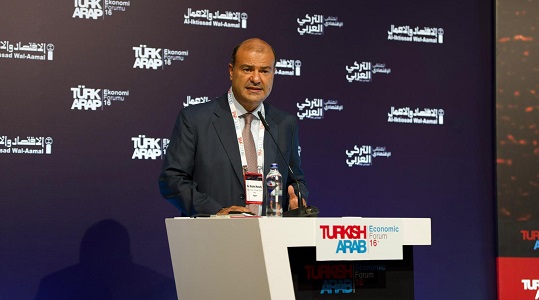
Dr. Khaled Hanafy, Secretary General of the Union of Arab Chambers, emphasized during the opening of the “16th Arab-Turkish Economic Forum”, held in Istanbul on October 2, 2025, and organized by Group of Economy and Business in cooperation with the Turkish Ministry of Treasury and Finance, with the official support of the Turkish Ministry of Foreign Affairs, the Investment and Development Promotion Office at the Presidency of the Republic of Turkey, in close cooperation with the Union of Arab Chambers, the League of Arab States, the Gulf Cooperation Council, and the Union of Chambers and Commodity Exchanges of Turkey, with high-level participation from ministers, heads of organizations, and leaders of the private sector in Turkey and the Arab region, in addition to Ambassador Hossam Zaki, Assistant Secretary General of the League of Arab States, and a large number of Arab ambassadors accredited in Turkey, that: “The convening of this high-level economic forum comes at a time of utmost importance and sensitivity. Today, we are facing profound economic and political transformations at the global level, characterized by the rise of protectionist and fragmented trends in the international economic system. This increases the urgent need to strengthen regional integration and build bridges of economic cooperation between countries with shared interests and historical ties.”
He noted that “there are very significant opportunities for developing strategic ports and achieving a logistical renaissance in areas of high added value, particularly in light of Turkey’s major logistical capabilities and outlets. This can be invested in the Arab region, turning it into a key gateway not only to Africa but also a platform for access and transit to East Asia and South American countries, with which we have begun to forge alliances through the Arab League by establishing a logistical link between the Arab region and South America via Brazil.”
He stressed that “given the geopolitical, demographic, and environmental changes the world is witnessing, it is essential to rethink the nature of our relationship. There are important opportunities for investment to transition the Arab-Turkish relationship from its traditional framework—focused mainly on trade development—to broader horizons, reaching strategic partnership. This has already begun through efforts to establish a joint Arab-Turkish Chamber, coordinated between the Union of Arab Chambers, the League of Arab States, and the Union of Turkish Commodity Exchanges. This new entity will contribute to consolidating Arab-Turkish relations through the private sector, which plays a leading role in both Turkey and the Arab countries, paving the way for alliances built on services, industrial activity, the digital economy, and the Fourth Industrial Revolution.”
Dr. Khaled Hanafy considered that “Arab-Turkish economic relations possess a deep historical legacy and tremendous untapped potential. By enhancing trade exchange, integrating logistical and industrial value chains, facilitating capital flows and investments, and sharing expertise and technologies in vital sectors such as renewable energy, food security, infrastructure, Islamic finance, fintech, and digitization, we can build a successful and sustainable model of economic integration that serves more than 400 million people across the Arab region and Turkey, strengthening our collective ability to face global challenges and risks.”
He explained that “the forum’s rich agenda—from the session on ‘Regional Integration: A Cure for Global Fragmentation’ with the participation of ministers focusing on financial coordination policies and regional safety nets, through specialized sessions on Syria and pathways for reconstruction and stability, Iraq and its economic transformation and latent potential, Libya and its recovery prospects, and concluding with the session on Islamic and banking finance and the outlook for sukuk and digital transformation—represents genuine levers for sustainable development and practical work plans to build a more stable and prosperous future for coming generations. These sessions confirm the pivotal role of the private sector as the main driver of growth, and the importance of Arab-Turkish partnership in designing and implementing reconstruction and development projects.”
He also highlighted that “the Union of Arab Chambers, which represents the Arab private sector in more than 22 Arab countries in addition to 16 joint Arab-foreign chambers, is fully aware of the scale of responsibility and the opportunities ahead. From this platform, we affirm our full commitment to supporting and strengthening all efforts aimed at enhancing economic and investment cooperation between both sides, working to remove operational and legislative obstacles facing investors and companies, and contributing to building a joint economic vision that benefits from the comparative advantages of both parties.”
The Secretary General called for “the importance of achieving successful and mutually beneficial economic and trade partnerships, to serve as a new cornerstone in Arab-Turkish cooperation and to help drive development and prosperity in our Arab and Islamic region.”
Source (Union of Arab Chambers)
